
Tiny House Frequently Asked Questions
Q: What is a tiny house?
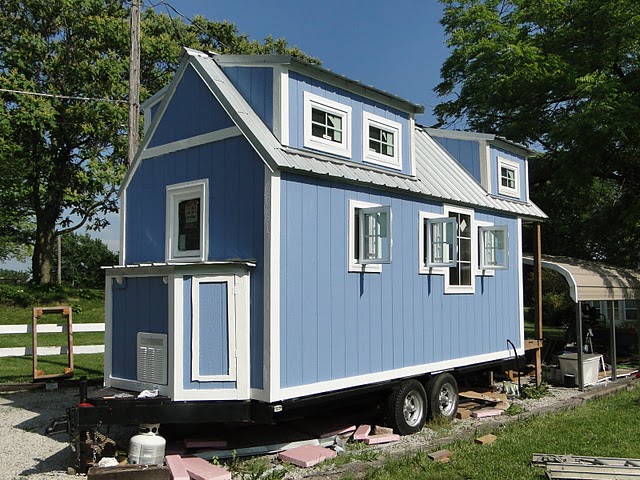
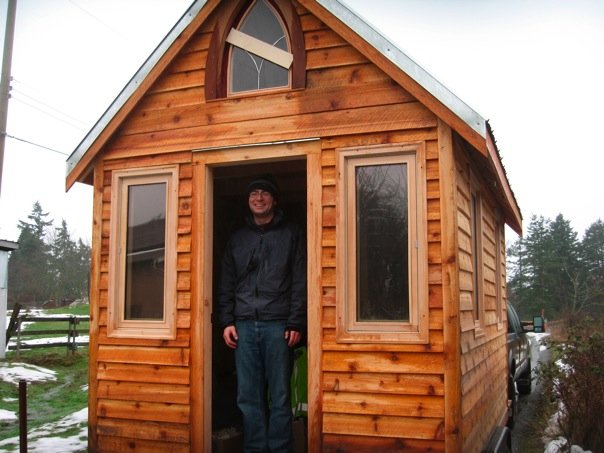
When most folks use the term tiny house, they are often referring to a home built using conventional methods but on the scale of an RV travel trailer. These homes are often built on flatbed trailers and are owner-built. Their square footage usually does not surpass 300 square feet. But small cabins, cottages, and other small residences can also be considered tiny houses. So the term is not so much an exclusive definition, but an inclusive category of extremely small residences.
Q: How much does a tiny house cost?
Many people choose to build tiny homes themselves with their own design or house plans they find online. When materials are chosen carefully, the price of a home can be brought down significantly. Anecdotal evidence shows us that owner-builders typically spend between $15,000 and $25,000 on their homes, not including their own labor. We’ve seen projects that come in under $10,000 too. Professionally build tiny homes are typically priced between $30,000 and $50,000. Tiny houses can go over $50,000.
Q: Can I finance a tiny home?
Most folks don’t borrow money to build their tiny homes. A more common path to tiny home ownership is to first downsize expenses and possessions, save money, secure a place to build the house, and then start the build. It’s a slower path into a tiny home than taking out a loan, but seems to be most common.
Some tiny house companies have been able to secure financing options by joining the Recreational Vehicle Industry Association (RVIA) and building their homes to those standards. This route can get you into a tiny home faster, albeit with a mortgage. The Tumbleweed Tiny House Company is an example of a company that builds homes that meet RVIA standards.
Another option that may work for you is crowdfunding your project through a website like Kickstarter or Indiegogo. A crowdfunding campaign typically offers rewards that are produced by the project to backers that contribute money.
A successful crowdfunding campaign typically depends on the perceived value of the rewards by backers and the effectiveness of your marketing. In other words, if you offer great stuff to backers at fair market prices, and you are able to tell a lot of people about the project, the potential of success increases. If you decide to go this route feel free to let me know and I’d be happy to post news of it. Just send an email to [email protected].
Q: Where can I buy a tiny house?
There are many builders around the world. Check the Tiny House Map and select ‘Builders’ on the search bar. Also be sure to check Tiny House Listings for owner-built & professionally-built tiny homes.
You might also consider looking at sheds and shed builders. In many towns you’ll come across roadside businesses that sell tiny sheds, barns, and cabins. You may also see these at your home improvement stores. Not all sheds are built in such a way that they can be finished-off as a tiny home, but with some clever tinkering many can. Sometimes these sheds can be financed, depending on the seller.
Another consideration is to simply find a good contractor near you that’s willing to build a tiny home for you. Not all contractors have the skills or knowledge to build a house from start to finish but many can. The disadvantage of this route is cost, the advantage is you get what you want and if the contractor does good work you’ll end up with a quality home without breaking a sweat.
Q: Where can I buy plans to build a tiny house?
Many of the builders also sell tiny house plans. Check the Tiny House Map and select ‘Builders’ on the search bar. Here are a few other places to get plans. Feel free to suggest more, just send me an email at [email protected].
- Tiny House Design
- Tiny Home Builders
- Sonoma Shanty
- Four Lights Tiny Homes
- iStockHousePlans
- FreeGreen.com
- Yes Wee Cabins
- Tiny Green Cabins
- Tumbleweed Tiny House Company
Q: Where can I learn more about tiny houses online?
The Internet is a great place to learn. Here are a few websites to start your search. Feel free to suggest more, just send me an email at [email protected].
- Tiny House Design (you are here now)
- Tiny House Blog
- Tiny Home Builders
- Tumbleweed Tiny House Company
- DIY-Prefab
- The Tiny Life
- RelaxShax’s Blog
- Shedworking
- Small House Society
- Lloyd Kahn’s Blog
- Project Rolling Freedom
Q: Where can I park or build a tiny house?
Most people park their mobile tiny homes on their own property or at friend or relative’s place. Some folks travel and move around from place to place. RV trailer parks may be an option too, especially if the tiny home has RV or conventional plumbing.
The truth is that tiny houses are still in a grey area and zoning & ordinances don’t really account for this type of alternative housing – but this is changing. Some communities are adapting as the popularity of tiny homes increases. To find out if your community allows tiny homes check with your local planning department. It may be wise to use words other than ‘tiny house’ and instead tell them what you want to do.
For example, if you want to build a tiny house on wheels, you might tell them you’re considering building a house on a flatbed trailer that you hope to live in – and tell them where. Then ask if there are any allowances for that in your community like that. For example would your community consider that an RV, or an ADU (accessory dwelling unit, a.k.a. granny unit), and is it legal to use it as a dwelling in your community. Every community has different codes, zoning, and ordinance so it pays to do some research.
Q: Are tiny houses legal?
It depends where you are and how you use it. Some communities have few building restrictions and are very friendly to alternative housing solutions. Other places have rules coming out their ears plus oodles of uptight neighbors that don’t want people living in their neighbor’s backyard.
People who are motivated to find solutions to their housing challenges will find the ingenuity in themselves to make it happen. The best advice I have on this is to research and learn as much as you can about the community you want to live in, and look for zoning loopholes and alternative housing friendly neighbors.
Tiny houses can also be built on foundations with permits if you want to go that route. Not all communities have minimum dwelling size rules but often the biggest hurdle is getting an exception to the minimum square footage requirement.
One common loophole for this is to look for land zoned for multi-family housing (i.e.: apartments) and then get a permit to build a tiny house. It’s common for multi-family zoned areas to have no minimum size for dwellings because these zones must allow for small apartments.
Another option is to look into the ADU (accessory dwelling unit, a.k.a. granny unit/mother in law house) allowances. Many communities allow a small house to be built in the backyard of a larger home if the dwelling is to be used for family or caretakers – and not rented out.
Q: Do I need building permits to build a tiny house?
If a tiny house is built on a trailer it typically falls into the category of ‘travel trailer’ and building codes don’t normally apply. But it is best to build to standard building codes and make sure your house is strong enough to withstand highway speeds. A good approach is to build the house with the same materials & methods used in locations subject to hurricanes.
If a tiny house fits the definition of a shed it may not need permits, although it also may not be legal to use as a dwelling. It’s always best to check with your local planning department before building anything, look for the loopholes and know your local laws.
Q: What kind of toilets do people install in a tiny houses?
Most people are using composting toilets or RV toilets with waste tanks. The most popular composting toilet seems to be the lovable loo, a sawdust toilet developed by Joseph Jenkins. Once you get over the idea of doing your business in a bucket and covering it with sawdust you’ll realize this simple solution is far more sustainable, sensible, and environmentally friendly than other choices. It’s virtually free too, which is always a plus.
The main advantage of commercial composting toilets is that they break down the waste faster by adding air, movement, and heat. All of this extra help composts the material faster requiring less storage. A simple sawdust toilet also requires a compost bin/pile so it can cook for a couple years. After that time the compost is safe for the garden.
If you build a mobile tiny house and plan to move it from place to place a commercial composing toilet is probably a better choice. If you stay on your own land a sawdust toilet may be the way to go.
Q: How do I heat and cool a tiny house?
For heating, most people use small propane heaters or electric space heaters if they have a utility grid connection. There are many marine propane heaters on the market. Some people use wood stoves but they tend to overheat such small spaces.
For cooling, air conditioners are the most common choice. A very small window unit is often ample for a tiny home that’s on the grid. If you’re off-grid it’s not practical due to the high energy requirements… in other words it would take a lot of panels/batteries to keep a place cool with an air conditioner in a hot environment.
Q: How do I deal with waste water (grey water)?
Many people setup their homes with grey water tanks like an RV but if you are living in one place setting up a grey water system seems ideal. If you have access to a sewer system and have the proper plumbing your waste water can go there just like a conventional home.
Q: What are the size / weight limitations for tiny houses?
Each state/region has different rules. Typically trailers aren’t much longer than 38′ or 40′, and tiny homes don’t often get longer than 24′. Weight considerations for tiny houses don’t typically push the oversize road limits; but they do push the limits for height and width. Typically 13′ 6″ in height and 8′ 6″ in width are the maximum dimensions without requiring a special move permit.
To give you a better idea of legal road limits for trailer, here’s a quick guide for truck lengths in California.
Q: How much does a tiny house weigh?
- 16-foot = 7,200#
- 20-foot = 9,000#
- 24-foot = 10,800#
- 28-foot = 12,600#
Q: What kind of trailer should I build my tiny house on?
Q: Can a family live in a tiny house?
Sure, and there is no one-size-fits-all for housing. A family will need more space than an individual or couple. People that work from home will need more space. The whole idea of living simply in small spaces is that the true value of the home is realized, and the home doesn’t become a burden. In other words it’s about finding balance and the first step is reducing the number of possessions.
Q: Land is so expensive, how can I live mortgage free?
In some places land is expensive, probably due to too many regulations and demand. But there are still many places where land is cheap. The trade-off is usually location or the quality of the land.
Lamar at Simple Solar Homesteading has done a great job showing people how to live mortgage free and find cheap places to live. This is in fact one of the main reasons I blog about tiny houses. I’m really searching for the true value of a home and I don’t think homes should cost any where near what they do.
Q: Where can I learn to live more sustainably?
Tammy at RowdyKittens writes a lot about living a minimalist life and regularly shares her learnings. If you want to peek into other extreme sustainable lifestyles investigate places like the Dancing Rabbit Ecovillage, and the Pickards Mountain Eco-Institute.
Q: Are tiny houses off-the-grid?
Any tiny house can be powered by off-grid electricity, but like any off-grid house choosing to use less power will get you the lowest cost system. Giving up things like microwaves, electric heaters, blow dryers, and electric clothes dryers, will allow you to really scale down your electricity needs.
Q: How do I insure a tiny house?
Check with your insurance agent, and put it in terms they can undertand. Typically calling it a ‘custom travel trailer’, or cabin, will help them undertand what you are talking about.
Do You Have a Question?
If you have a question that’s not answered here send me an email at [email protected] and I’ll try to answer it. The answers above are my opinions and should not be considered legal or professional advice.

Hey,
I live in Berea Ky. and I plan to build a tiny home w/i the next few months. I am currently looking for like minded folks to join me in purchasing a larger piece of property which we would divide for our individual homes.
In this way we could all afford a much nicer property. This could be anything from an eco-village to just individual properties perhaps with a shared park like space and/or a community garden area.
Berea is called “The Arts and Crafts Capital of Kentucky” with many and varied local artists and artisans plying their trades. We have an active sustainable living community, a health food store,farmers markets, and two solar home builders right here.
Berea is in a lovely geographic area, the foothills, it is not deep in the mountains but has mountain veiws and the wonderful rolling fields that central Ky. is known for. There are many beautiful places to hike, camp, bike, kayak etc. Wildlife is abundant.
The town itself has about everything one needs, but Richmond is only 10 min. away and Lexington 30 mins.
Sounds great Roxanne! Be sure to post that on the Tiny House Design facebook page if you haven’t already. http://www.facebook.com/pages/Tiny-House-Design/191921749223
Hi Roxanne,
I live in Lexington! I’m not sure I’m currently in position to go in on a peice of property, but I am very interested in your venture. Any way you could keep me in the loop?
Roxanne,
I live in Louisville and work in Knoxville, and am looking for someplace halfway between the two to put a tiny house. This would be perfect for me — I stop in Berea often and love the vibe there.
Not sure I’m in a position to buy land ASAP but I’d definitely like to learn more — please keep me posted.
Please let me know your ideas, I’m really interested!
Roxanne,
Sounds wonderful! I am from Kentucky originally and my husband and I are looking to escape the outrageous costs of California life. Please write to me and give us a little more info. We love Berea and Pleasant Hill – sites of many vacations over the years.
Saw your post. Did you build your tiny home? I live in berea, and is very interested in build ing a tiny home…what are the restrictions?
We are a couple who owns a tiny house (only 15 ft. long and 7 ft. wide).
Luc is a piano technician and I am in the process of becoming a yoga teacher.
Luc’s job is bringing him to Lexington during Sept-Dec and we will need to move our tiny house closer to there.
Currently we are in Cincinnati. We are looking for a place which is a bit closer to Lexington. Covington or anything south of that would be great.
We plug in an electrical cord from our house to whoever’s house we stay at and also we would need to connect a water hose to our house.
Alternatively we could park our house in Cincinnati for the winter and rent a sublet for the winter, so we are also interested in any Lexington sublets for Sept-Dec.
If you have a driveway, yard, or lot which you think might work I’d love to hear from you.We would be able to pay some rent and utilities or exchange work, such as gardening or french lessons.
A new website that’s popped up to help with finding places to live is: http://tinyhouseparking.com
GREAT STUFF!
I’ve been building a tiny house in Austin, TX that I plan to sell in the next month or so. I’ve documented every major step with pictures for anyone else wanting to build one.
Thanks for the heads up Louis!
Hi Louise, my boyfriend and I are building a 10×10 in September. Our challenge is that we want to build it for 5,000$ max.
I am curious about your photo’s or building plans.
Can I send you my contact info?
Cheers,
Sarah
Sure, Sarah. I’ve been posting photos and a video at http://www.austintinyhouse.com. My contact info is there too.
Love the concept, and could easily live in one, but the hard part is finding a place to put it!
I advertised on Craigslist. Found a retired couple with several acres and dogs who travel a lot (the people travel, not the dogs) :-D. I don’t have to pay rent, mortgage, or utilities and they can travel freely knowing their pets and home are well cared for.
Baby boomers are retiring in droves these days. There’s a good chance you could find something like this in your area.
Good luck!
How to find parking for your tiny house:
https://m.youtube.com/watch?v=ffgdozABtdA
I was curious about how pets deal with a tiny house. Particularly cats. I am very interested in possibly building one, but I have two cats, and I wouldn’t want to have to give them up!
I don’t think cats would have trouble with a small space… but where to put the litter box would present a bit of a design challenge. Other small space cat owners are:
http://rowdykittens.com/
http://www.whittleddown.com/
http://www.comingunmoored.com/
Ethan’s tiny house with a pet door for cats:
https://m.youtube.com/watch?v=oGMk5bYpHkg
Michael – Thanks for the shout out. And I loved this Q & A. Very informative stuff. 🙂
@Natalie – Don’t worry you won’t have to give up your kitten. They do fine in small spaces. 🙂
I am awake at 1am because I stumbled onto this page and I am in love! I have a husband, a beagle, and a two year old son though. I would love to hear from anyone else who has downsized/simplified/gone true green with young kids.
Families living in tiny homes:
https://m.youtube.com/results?q=tiny%20house%20for%20family&sm=3
Having a tiny house for me is a bit complicated and very challenging because of restrictions in other places and maintaining it is one thing. But I’d love to have one if given the chance. Thanks for the post, I’ve learned a lot from it.
Please keep me in the loop. We have been considering doing this for about 3 years.
What are some ways to vet a tiny house builder before going under contract? How can people avoid, for example, craigslist scams?
What are some tips to establish and maintain a good working relationship with a long distance builder?
Ask for references and contact previous customers.
I am considering building one of these in the Los Angeles County area, and have been told that the California Coastal Commission does not allow smaller structures to be built. I have been looking around and have found some cheap land in the Santa Monica Mountains that makes me drool, sometimes even just a few steps away from amazing views, and love living here, despite being bombarded by the lifestyle that I am trying hard to remove myself from. As I am a student, my goal was to save money (car living) the next two years from my job and living expenses, and build and design a small home in the mountains. Any advice would be great. I am ok with taking on as much as $50,000 in land out here, which would be kind of unavoidable, and the best way to “own” your tiny home. I plan on going on the grid for now (baby steps) but have studied it and think that maybe sometime in the future I may decide to go off. Again, thanks, and I love this blog…like a previous poster, I too lost sleep over this when I first found it…so easy, so sensible, and yet, so SCARY to some people! Ha! I’d rather own a tiny house in five places by the time I retire as opposed to one home I can barely keep up…
Many people are building several tiny houses on wheels on a piece of property to avoid taxes. For example, a central bath and kitchen building surrounded by smaller dwellings.
Hello, My name is Caleb and I’m in the process of building a Tiny house and have run into a few issues and was hoping you could give me your opinion.
I started with an old trailer from the 70’s and have completely torn it down, I’m starting the framing but have realized there is no way I can get the blackwater tank under the new placement of the toilet. So I’ve been looking for “trailer codes” online but I can’t find any answers,
What i was thinking I’d do was try to use to 90 degree turns and a length of 2.5″ ABS piping to connect the toilet to the tank intake
I’d appreciate any advice you can give me,
Thanks
-Caleb
My understanding is that the travel trailer industry regulates itself. I know that sounds odd but seems to be true. You can find the standards here: http://www.rvia.org/?ESID=sande
I suspect fewer 90 degree turns is always better in plumbing especially in sewer drains. If two 45s could be used in the same small space I might try that instead… but then again it’s such a small run you might be just fine doing it the way you described.
Being a do-it-yourselfer myself I would also check a plumbing guide just to be sure I’m not doing something I might regret.
Consider a composting toilet.
I’m interested to talk to someone who has actually traveled on the road with a tiny house. I am looking to retire this way, but want to forsee stumbling blocks before hand.I need info on a non electric non pluming home.
How large of a truck is needed?
Thank you
Eileen
Tiny house journey:
https://m.youtube.com/watch?v=y1oqcA4DFKw
Michael, you have a great site with many well thought out Tiny house designs. The plans are straight forward and easy to read. I recently purchased the Pioneer’s Cabin framing plans from you which I will be building, a little gem of a building and excellent vaue for money. But please do a metric version along side your imperial version for all us guys in Europe.
Love your website. I’ve recently started a tiny house business. I am on facebook @ http://www.facebook.com/hummingbirdtinyspaces/
and I have a website http://www.HummingbirdTinySpaces.com
Check me out…
Would like to be considered for your links also
Will in TN
How long does it take to get the ebook? Paid by Paypal (PAD 298) and can’t figure out where I go to get the two ebooks! Thanks
Hi Paul. I sent you an email a couple days ago but have not heard back. Please email me at [email protected]. I’ve looked high and low for this transaction and can’t find it.
You forgot Humble Homes (humble-homes.com) for a website from which to buy plans! They have some of the nicest layouts, innovative designs, and have 3D renderings of their interiors. Plus, their plans are some of the cheapest around! I actually plan on modifying their design that includes a staircase. They don’t seem as well-known as they should be.
http://humble-homes.com/tiny-house-plans/
I live in a tiny house. It’s stationary, is made of bricks and mortar, is fully plumbed and powered by national grid electricity and gas. I live alongside hundreds of like minded individuals and families.
It’s called an apartment and it’s in a block with 40 others just like it. Concentrated urban dwelling is better for the environment than thinly-spread rural or suburban dwelling of the established kind.
A mobile tiny house is a romantic idea that I would love to try, but I don’t think my wife would agree! I’m also interested in the idea of stealth camper vans: go anywhere homes bult into standard small delivery vehicles.
This is a great list. Thanks for sharing! Would love to a see an FAQ devoted solely to off-grid questions for tiny homes (maybe I should be the one to make that one.) Again, thanks!
Off-grid tiny houses:
https://m.youtube.com/results?q=offgrid%20tiny%20houses&sm=3
I believe I ordered and received the Tiny Solar House plan before and lost it when I couldn’t use my computer or my external hard drive anymore. Could I have a free replacement? It may not have even been this email that I used. Thank you for any help.
You bet! I just sent a reactivated link to you via e-junkie.
MIchael, I am an architect and historic restoration craftsman and am very impressed with your site and projects. My wife and I built our own small house south of Austin finished mostly with reclaimed material and wondered if you’d be interested in a story and a few photos. We love our place and have been happily living mortgage free ever since!
Is there a link to view this house?
Yesweecabins.com no longer is up.
We are looking for a site that lists tiny houses that are open for touring. We want to SEE & TOUCH a few before we get started. Any ideas? I’ve found the “map” option at http://www.tinyhousemap.com but that didn’t help much.
Where are you located?
near Frederick, MD but my folks live near Seattle, WA. They’re actually driving back this week & were hoping to find some to look at along the way. They’re taking 90 or 94 depending on if i could find a stop for them.
I just got off the phone with Frederick County zoning & permits. They won’t allow tiny houses on wheels because it doesn’t have a HUD sticker. They said they would treat it as a camper.
Did you find any in the area to tour?
I have a friend who has a 5 acre piece of land in Northwest Florida that is available for a community of tiny homes. It has a small newer home on the property for a community center, shelter etc. Great for a community garden and is zoned to have farm animals as well. The price for the entire 5 acres and small main house is $125,000 . This is a great opportunity for a group to purchase the land together, or for a like minded individual to own and rent lots. This property is private and secluded, yet close enough to Pensacola. Get it while it lasts. It’s priced to move quickly.
Is there a website link or email address?
Over here in Europe (the Netherlands) one can buy an affordable wooden cabin for around €5000,- in a Built it Together Yourself package.
We are talking about a cabin with real (massive) 40 mm wooden sidewalls and floors, plywood on the roof, finished with sheetroofing and (necessary in our climate) double glazing.
You think its just a shed? With 25 mtr² (5×5 mtr) its not a tiny home either, think of 16 feet 427⁄32 inch by 16 feet 427⁄32 inch OR 269.10ft²
Wanna have a look?
http://www.primablokhutten.nl/nostalgische-blokhutten/kitzbuhl-met-luifel/blokhut-kitzbuhl-5x5l/
Ohw, set your translation from Dutch to English!
Have a nice day,
Martin Green
I love the idea of sustainable living – living in the foothills of the Smokies offer many lovely parcels of land and the thought of living among like minded folks greatly appeals to myself and my husband but unsure as if there is such a group that does indeed exist here . If you or someone you know please drop me a line.
Have a blessed day!
Wendy and Mike Carroll
I would like some information (In Print) on building a Tiny House as well as any other information that you may be able to supply
mailing address is Po Box 59 Wolfeboro Falls, NH 03896
There are also plenty of instructional videos online for various aspects that are specific to building a tiny house:
https://m.youtube.com/results?q=how%20to%20build%20tiny%20house&sm=3
Tiny house communitires in different states:
http://tinyhousetalk.com/communities/
Recreational Vehicle Industry Association Standards:
http://www.rvia.org/?ESID=Standards
When finding a builder, ask if they are licensed and insured. Ask if the building may be inspected by an electrician, plumber or building inspector. For quality, consider a finish carpenter or cabinetmaker.
Additional websites:
http://tinyhousetalk.com/
http://tinyhouselistings.com/
http://www.fourlightshouses.com/pages/tiny-houses
If a home is not set up according to code, it may be more difficult to insure. Codes for wood stoves and staircases can be easily found online.
Products to green your grey water:
https://m.youtube.com/watch?v=kGA73mVHiQ4
I have become very interested in building a tiny house village for the homeless folks in my hometown of Harlan, KY. I no longer live there, but am aware of the great need as there is no longer an operating homeless shelter. Does anyone know of any grants that can be applied for to help in this matter? I am hopeful that I can get volunteer labor and a few items donated, but there will be a large cost that I can’t afford and if anyone knows of a way to find funding, I would be forever grateful!
Hey, I need help to find out if in California, the Tiny house living is legal?, to specify, Southern California.
Hello myself and my wife moved to Kentucky about 4 years ago we first found a 1.5 ac . on craiglist it was not a bad deal the cleaning and clearing took a bit,but it’s ready for building i was thinking a tiny house,would be perfect it’s has septic tank city water,but we moved 7 miles up the road to the next town we still have the property. If anyone might be interested
Hello! Where in Ky is the property located?
This is so helpful! 🙂 I was just wondering how do you store water in that tiny house? Sorry I don’t really know that’s why I’m asking. Thank you very much! God bless you 🙂
Some people build-in RV tanks but I think most simply rely on a water source like a potable water hose from the property they park the house on.
I have picked out a “tiny house” (classified as a park model RV) from a local company and now I am unable to find any financing for it. The house was built by Lil Lodges: http://lillodges.com/ in Bear Creek, AL. I want to put it on my own land and I’m pulling in public utilities now to the property. Park Model RVs just don’t fit in financial institutions’ loan packages. I’ve been rejected by 11 or 12 already!! I have excellent credit, worked at my current job over 16 years – I don’t see the risk! Who will finance these homes? PLEASE HELP!!
Have you tried local credit unions? I’m surprised the builder doesn’t have more information available for you.
Hi Juanita; I hope you have already solved your loan problem, but if not, let me perhaps stear you in a better direction… a tiny house on wheels, is leagally a recreational vehicle if it’s size adheres to that standard ( 8.5 feet wide max, x 41 feet long max ( including the tongue) over those limits puts it into the mobile home catagory…. as an ex- loan originater, I can tell you that the type of loan you need for your Fv, is more in the personal loan type, like you would seek for a car, because your RV is treated the same way by the DMV….now, you can seek a loan just on your land alone, without the RV…for improvements .There are mortgage cos who do handle land loans…. I think trying to bundle your RV with the land improvements is what is disqualifying you… mobile homes don’t even qualify for mortgage loans unless they are put on 8-point foundation; like a conventional house sits on. I hope you get your needs met….blessings to you in your new tiny home! As P.S. to everyone; a “Park Model” is an RV that is not self-contained; meaning, it does not have grey/blackwater sewage holding tanks, and fresh water storage tanks, so it must be hooked into a sewer and a water line…like most RV parks have available…there is a mis-conception with this term lately amongst the tiny house folks; possible because many are not typical RVers, so that world is new to them…I am, though, and I have restored and lived in RVs since 1986….we were the first “tiny house” people, and there’s nothing freer! So, you only need special transport permits to move a house/mobile home; not a park model trailer.
On June 16, I purchased two plans for half price, (Leggett 24 and Laytonville) and sent to DropBox. When I try to open them or copy them it say’s files are corrupted. I have not used DropBox before, so maybe I did something wrong. Is there a way I can download those again?
I own a new tiny house in Austin and looking for land or a private and owner who would like to rent a space out. I am currently at an rv park. Its ok but pay too much and dont like my neighbors so much. I dont have to live in Austin. Outside the city limits is fine.
Hey, That’s funny. All your tiny house plans are named after places in my neck of the woods. What a coincidence. Great site, btw.
I WAS SHOCKED TODAY TO FIND AN EBAY SELLER TRYING TO PASS TWO OF THE FREE PLANS BEING GIVEN AWAY AS HIS OWN
SAYING HE IS A PROFESSIONAL AND THEIR HIS OWN DESIGNS.SMH
http://www.ebay.com/itm/Build-your-own-8-X-20-Tiny-house-DIY-Plans-Fun-to-build-/292019248577?hash=item43fdb41dc1:g:TJsAAOSwjDZYlc5d
http://www.ebay.com/itm/Build-a-24-X-12-Settlers-tiny-house-with-loft-DIY-Plans-/302184021903?hash=item465b923f8f:g:az4AAOSwUKxYaWI2
NO WONDER HE NEVER ANSWERED ANY OF MY QUESTIONS
Thanks for letting me know.
when you say that the house can only be 13’6″ high is that measurement including the trailer
Yes total height from the ground
Thanks for helping me learn more about tiny houses. I didn’t know that people usually have propane heaters to help heat and cool a tiny house. I’m interested to learn if they should also find a place to store extra propane so that they can heat the house when they need it.
Hello everybody.
Thank you for you very much interesting blog.
I’m a girl from Spain who was in the project of designing her own tiny house and I have a question is about the distribution of the weight.
Due to the strict rules on the length of vehicles in my country, I want to place the door at the part of the coupling of the trailer to install a collapsible porch on oblique crossbar. That will leave me with the bedroom area at the end of the trailer and the kitchen and bathroom are in the middle. At the beginning there would be a sofa bed with storage, electric box and a storage closet. Above that, on the second floor, there would be my work area and over the bedroom another small loft for storage.
Can I do that if I have a wheel axle at the beginning of the trailer and another at the end?
Thank you very much.
(I apologize for my bad English and I hope you understand me. :3)
Your english is great. I’m not sure I understand the layout and location of the axles though. Could you draw a rough sketch of the design and email it to me at [email protected] ? You could just take a quick photo of the sketch and send it that way. Thanks!
Hi there I am wanting to build a 28 foot trailer and I expect it to weigh 15,000-19,000 pounds. How high can I build my tiny house frame? With 13.5 feet in mind how many inches can I expect the suspension to lower? How do I calculate that? Any suggestions? Thank you in advance, Julia
I recommend using the deck height of the unloaded trailer. Pushing the limit is risky and if the trailer’s springs are properly sized to the load it shouldn’t drop more than a couple inches. You could use the bump stop as the max drop under load too.
Hello Michael,
I tried to find your response to my set of questions, posted earlier this month (Aug. 2019), and the most recent I see is June 11, 2019. I am looking in the FAQ’s postings. Is there another location on your webpage where I should be looking?
Thank you. Dennis