
How to Move Yourself Off The Grid
It’s easy to take flush toilets, grid-power, and fresh water on tap for granted. I can’t blame any of us for thinking that all these modern conveniences are normal… it’s the onlynormal we’ve known. Due to this most folks have a hard time imagining an off-the-grid life because it’s not clear what’s needed to make the leap.
So here’s a crash course in practical and sustainable solutions for moving yourself off-the-grid.
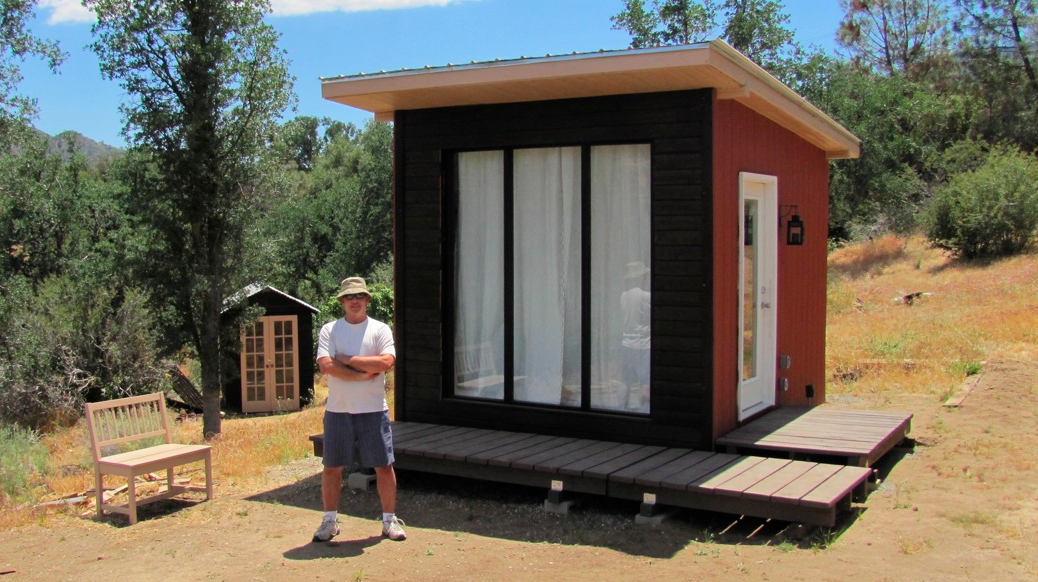
Photo of The Urban Rancher and his off-grid cabin.
Pee and Poop
Flush toilets are really insane when you stop to think about what they do. They begin by taking several gallons of perfectly good drinking water and mix it with a little pee and poop to produce sewage. Sewage is a mess and really hard to turn back into safe drinking water; but it is easy to transport to treatment plants through enormous networks of pipes, an infrastructure that need regular maintenance. To clean it up, chemicals are used to treat the water which in-turn keeps everyone in the chemical business very happy. Isn’t there a better way!?
Compost it! – Poop loves to decompose and if given a little time and the right conditions it breaks down into rich compost, yes even human poop. Remember we’re just critters just like the our furry friends and our poop will actually decompose into a safe compost, under the right conditions.
Humanure Handbook – A fellow by the name of Joseph Jenkins has actually written an book on the topic called the Humanure Handbook. He’s also designed a toilet nicknamed, The Lovable Loo, which is essentially a 5 gallon plastic bucket in a plywood box. You might also hear these toilets referred to as sawdust toilets because sawdust is literally used to cover the deposits between visits.
The other component you need with this system is a dedicated compost pile out in the backyard with enough space to cook your poop for two years. The stink stays buried in the compost pile under a layer of straw. When you need to add a bucket load you simply pull back the straw, add the fresh material, and cover it back up. So there is some stinky work involved but the the chore is a simple one. This may also be the most sustainable, low-tech, and safe way to turn our waste into something useable.
Commercial Composting Toilets – If the virtually free sawdust toilet seems far too gross, consider spending around $1,000 for a commercially produced composting toilet. These units work swiftly to decompose the material making them more palatable by most folks. If you move your tiny house around a lot this kind of system would be much more practical than a Lovable Loo too, because it’s self-contained and required no backyard compost pile.
Greywater
Another somewhat tricky waste material to dispose-of is the runoff from sinks, showers, and laundry. This is referred to as greywater which will still have traces of human waste in it, so it can’t just be left to run down the street. In a normal house this water is mixed with sewage to make more sewage. Seems kind of silly doesn’t it?
The solution is to reuse and/or treat the water right there on-site instead of funneling it down a sewer line to a treatment plant miles away. There are many different high-tech and low-tech ways of dealing with greywater but if you choose to build a tiny house be sure to consider handling the plumbing for your sewage separately from your greywater. The people at Earthship Biotecture have an incredible greywater system that is built right into homes and could serve as a model for any home’s future greywater system.
Fresh Water
Instead of drilling a well or tapping into municipal water sources, consider collecting rainwater and storing it in tanks for year-round use. Rainwater harvesting is becoming more and more popular because it’s so simple and low-cost. It can also be perfectly healthy to drink with a little filtration. I wrote-up a detailed post on some ideas for rainwater harvesting which you might find useful.
Electricity
The power grid is an incredibly complex network that requires constant maintenance and monitoring. The entire system is actually incredibly inefficient. For example, line loss, literally the resistance in the wires, sucks electricity from the system before it reaches its destination in your home. To compensate the utility company has to produce more just to defeat the inefficiencies of the system.
Imagine a world where people made their own clean electricity at their point of use. For such a system to remain low-cost we’d need to learn to use less power and move way from using the energy hogging appliances that grew-up dependent on fossil fuel sourced grid power. We’d also need to invest in our own off-grid systems up-front. The good news is that alternative power options are coming down in cost.
Photovoltaic (PV) Solar Panel – Most folks these days are familiar with this technology, panels that produce electricity when exposed to direct sunlight. For a tiny house and a frugal occupant a few solar panels, batteries, and some simple electronic control equipment may be all that’s needed for an off-grid electric system.
Wind Turbine – If you tend to stay put and live in an area with ample wind, a small wind turbine can be a great addition to an off-grid system because it increases the diversity of you power sources. Many off-grid systems also include a backup generator that is used to charge up the batteries when the sun is not shining. By adding other renewable sources of electricity, like wind and hydro, you can reduce your dependency on fossil fuel burning generators.
Micro-Hydro – If your land has water running crossing it, and you have water rights to it, you may be able to tap a small portion of it and spin a small turbine. This can be one of the most reliable and steady ways to produce electricity because as long as the water flows you have water.
All that is needed is a drop in elevation between the inlet and the turbine, some pipe, and a way to get a small portion of the water out of the stream and delivered to the tiny turbine. The inlet can simply be a submerged bucket with a pipe connected that brings the debris-free water downhill to the turbine.
Heating & Cooking Fuels
In most modern homes natural gas, propane, and heating oil are the common fuels burned. But we’re really beginning to see the true cost of using these limited natural resources. If we moved from being dependent on fossil fuels to using renewable energy sources we’d significantly reduce the risk of rising energy costs and continued environmental impacts.
Wood – Burning wood is actually a carbon neutral way of heating a home. When a tree grows it absorbs carbon. When we burn it it releases that same carbon. If we use a highly efficient wood stove in a small living space we can actually get through the winters with little environmental impact and effort. The problem with burning wood for heating a large home is that it would take acres of trees to make it sustainable. Heating a small home requires less energy input which in turn reduces the cost, impact, and effort needed to stay warm in winter.
Methane – Some inventive folks have actually built systems that produce mathane gas from their waste, both human and vegetable. It’s rare to come across this kind of a setup, and they are reportedly a bit tricky to operate, but they can provide a renewable natural gas for cooking and heating.
Alcohol – I’ve not seen this done a great deal but the idea of having a small still for distilling alcohol for burning in an alcohol stove may be a viable alternative on a small scale.
Wrapping Up
In this modern world it’s hard to imagine life without fossil fuels, flush toilets, and fresh tap water. Actually I think it’s perfectly logical to say that without these things our lives would be very different.
Tiny houses are much easier to maintain in good or tough times. Every time we take-on one more square foot, we increase the effort required to maintain our living space. Living more simply and sustainably lowers risk and can increase our opportunities to prosper.
Changing the way we think about the basics is the first step in changing the way we live. Imagining downsizing to a smaller home and owning fewer possessions is a giant step. But it’s a giant leap for most to learn to live without the reliance of modern conveniences. Most of us are still on the way there too, living with a foot in both worlds, testing the water and exploring. I hope this little introduction to alternative utilities helped move you forward.


Hey–Just wanted to say that all these FAQs and primers you’ve been posting lately are FABULOUS! Super thoughtful and thorough. Thanks!
Thanks Libby. Love following your adventure too!
Libby said everything I wanted to say. Great information: to the point, links to further reading and resources, all major concerns discussed.
Thank you. I have bookmarked your webpage.
Best wishes, … D.
The Humanure Handbook is one of my favourite books and I was surprised by how interesting and entertaining it was to read it. I’m working on designing a system like the one Jenkins describes but to be used for a mobile application. There will be a composting toilet inside with a large composing bin outside attached to the trailer.
H Anne,
I’d love to see what you come up with! A low-cost low-tech portable composting toilet would be ideal… especially coupled with a portable soil box greywater system.
That’s what I had in mind for our greywater system at first but to save room I’m making a pvc pipe filter with sand and activated charcoal (like a giant fish tank filter.) Although, if our house was stationary, I’d love to set it up like the greywater planters they use in earthships.
Great idea about the filtration. My neighbor, when he recently moved, have me this 15″ tall filter that was used in a huge fish tank. I had intended to use it in my aquaculture system but it didn’t work out… but this use would be great — as a portable filter for a grey water system. Thanks for the re-use idea!
Can you tell me more about your activated charcoal system? Is it inside your tiny house? We’re building an off-grid tiny house now, and the greywater issue is a tricky one! One of the pro’s of building on a trailer is portability, so that rules out a complex Earthship-style system for us. We were planning on just dumping our greywater on the ground (yes, its legal in Arizona), or running an insulated pipe into a leech field. Either way, we’re a little concerned about everything freezing in the winter. If anyone else is living off-grid, I’d love to hear about what you’re doing about greywater.
We are beginning the building process off grid in AZ as well. We are in the NE region where it freezes. I would be interested in what you come up with for grey water. We plan on running ours on the ground to select trees.
We haven’t worked out the details, but are considering both a soil box (perhaps built like a winter grow box?) or a leech field. Neither is ideal since it’ll take some work developing our site, and we still need to do some more research on how deep underground the end of our pipe needs to be to avoid freezing water in the pipes. I would love to hear of someone’s personal experience on this, (I’m sure there’s got to be some off-grid cabins or tiny houses out there that do this in freezing conditions)
Have been using 3″-4″ pvc to drain grey water to the tree bed (about a 35ft run). Only 1 foot below ground. NEVER any freezing issues! In Northern Pennsylvania!
Nice basic walk-through of off-grid alternatives to public infrastructure. However i do react to some statements. Regarding how bad the “on-grid” sewage system is drinking water is not always something that’s hard to come by and there is no disadvantage of “wasting” it. It was quite some time ago i was on a tiny tour on my local sewage treatment plant but i don’t remember any chemicals being part of the process and reading about it i don’t see that it HAS to be used and are used everywhere.
And regarding the electric grid you probably have way less maintenance than if every one would have their own energy production. And small scale electric production is not as effective as large scale production. I would also guess that there would be much more bad, electronic waste with small scale productions since it more often would be cheaper to just buy a new generator than to fix the one you have.
Going off grid is very interesting and a great alternative but i don’t think it’s(always) greener. Tiny house people should actually be the ones that understand this the most. I mean the point of minimal living is to shed unnecessary possessions and borrow or rent things that you don’t use daily. Public and shared owning and production is more effective.
Now i guess i have a slightly different view on the subject living in Sweden with huge amount of freshwater and hydropower 🙂
Hi Andreas,
My bias against large infrastructures is based on one core philosophy, that diversity adds to sustainability. So you are correct to point out my generalizations, they are generalizations. Maybe I should have made it more clear in this post why I think diversity is so important, maybe I’ll do a full post on that, but I’ll give you the nutshell here.
In this case I’m advocating that people adopt a more self-sufficient and sustainable lifestyle because it would make the whole of our civilization stronger.
A decentralized model is not necessarily more efficient but it does spread our overall dependency over a wider area, lowering the overall risk.
How does “diversity [add] to sustainability?”
You were also advocating using only local resources and solutions, the opposite of spreading our overall dependency and increasing risk…
Diversity adds to sustainability by spreading the load and reducing risk. Just like in a natural environment you find that eco-systems are stronger as the fabric of life becomes more complex and diverse.
Each local region must be allowed to flourish and develop local diversity. When we become too dependent on a thinly spread global economy (or other system) the strength of the entire system weakens.
Spreading things like knowledge on the other hand would work fine at a global level. Trade relies on vast quantities of energy so is not sustainable in the same way as sending electrons around.
I don’t necessarily believe that there is less risks and less problems with localized energy production(or food production or anything else) but if(when) something happens the problems are huge compared to if the systems are localized. So while the risks for something to go wrong may be higher, the risk that a whole country or at least a part of a country would go under is gone. So while there might be problems, there won’t be catastrophes.
my reply fits better here than at the bottom because my general comment has been made over and over already: thank you Michael for an informative, well-founded and down-to-earth article. as a resolute city-dweller i would certainly have great differences of opinion on most details even though i share the heart of your philosophy that DRASTICALLY (meaning far beyond meatless mondays, carpooling and energy-saving lightbulbs) reduced consumption of resources is our future, if we are to have any future at all.
as for the exchange between you and andreas, who both have excellent points, what i can add for your reflection is that the french gov’t and national electric company (EDF) subsidize home photovoltaic systems with 1) tax breaks 2) a 20 year contract to buy your production at guaranteed prices and pump it INTO the grid. so though in the end you will recoup your investment and make money (not save it) you are not off the grid but DOUBLY tied to it. though this does indeed create renewable kWh, and if produced in an urban environment avoids the problem of transmission loss, there is no sea change in the way of doing things.
Thank you for putting together a really simple and straightforward article to going off-grid. I suspect the biggest obstacle for people is that, as you mention at the beginning of the article, we’ve always done things a certain way and that becomes ‘normal’. However if people are happy enough to change from living in a large dwelling to a tiny house, then they probably have the right mindset to accept other big changes too.
I myself have been experimenting with solar panels (a 10 watt and a 70 watt because that’s all I can afford), and the first thing that becomes obvious is that you’d have to DRASTICALLY reduce your electricity consumption for this to be viable – it’s not impossible, but a different approach to using electricity is needed – you plan your life according to what’s available.
I also take on board the comments from Andreas – solar panels, wind turbines etc all have a high production overhead which means that in reality, the electricity produced from them is quite expensive compared to the grid (you also usually need batteries – full of acid etc). I think you have to look at your motives for going off-grid – clearly if there is the possibility of hooking up to the mains electricity, then that might be your best option, but with mains, you don’t know whether it’s been produced using nuclear, dirty coal etc etc. If there’s no mains available, then off-grid becomes your only option. A better option would be to reside in a small community with it’s own green power generation facilities which is shared (shared cost, shared responsibility etc).
Many years ago, I visited a sewage treatment works here in the UK. I don’t know if it is typical, but the solid waste was separated and put into an anaerobic digester – this produced gas (which at that time was used locally for heating, but could easily be fed into storage tanks) and a wonderful soil enricher. The liquid waste was put through large bacterial filters and eventually fed back into a river as clean water. Chemicals are used when water is taken from source and treated to make it ‘suitable’ for drinking. I guess there may be different techniques used in different places, depending on local geography etc.
Hi Michael,
Great summary and of course going off grid can be done in degrees but even then, it is not a precondition of living in a tiny house. Any of these methods can be used to any degree by anyone to reduce our impact.
There is nothing to stimulate the thought process of how complex these systems have become and how much we take it for granted as buying a piece of land which has no access to centralized utilities and trying to design all of the things which you would need to build and live there. You very quickly come to grips with putting in simpler systems and come to the same conclusions and solutions which our predecessors used for centuries. Pit toilets, collect your water, burn what you have for fuel, reduce your consumption by a lot compared to what we do today.
And to Andreas, I live in an area where there is also lots of freshwater and hydro power and yet water is a topic of huge discussion because we are rapidly running out. It is over-allocated. Everyone wants a piece – farmers to irrigate more and more land, industry for manufacture, homeowners to keep their lawns green. The amount of consumption per person is unsustainable and more and more pressure is placed on every single running body of water to tap it, dam it, ship it, redirect it, channel it. OTOH, we have water so clean it can be drunk from the stream and yet, chemicals (like chlorine) are still added to it before it becomes drinking water because of potential from farm runoff. We’re not the only ones pissing in our drinking water. We should never again think of any resource as being limitless because it is just a matter of time…
Well sure it’s not all about the amount of water you have access to but the amount of people to share the water, industry, climate, culture and so on. I don’t really know any one that waters their lawn and i haven’t heard about any water shortages in Sweden other than very local problems. Obviously there are differences between our situation, maybe Sweden have even more water, maybe there is difference in population density, growing crops more suitable for the climate and so on. My point that it’s not always hard to come by still stands even though i agree that how some treat their surroundings and resources is downright offensive.
I am curious how a mobile composting toilet/grey water system would work. Since at least the compost needs to decompose for several years you would either have to haul a lot of waste or find a place to deposit it. Either way not very mobile friendly.
I think you could do it as two separate systems. The greywater could be a small soil box, like an earthship. The problem is capacity, so you’d need to watch water use. There may also be a clever way to encourage evaporation to get rid of the water too. I’m picturing a tank with a mini-tromb wall on one side to keep the water warm.
I would think the mobile sawdust toilet composter would have to literally be a compost pile, maybe similar to a commercial composting toilet in that it spins, heats, and aerates. Follow Anne’s blog to see what she comes up with: http://mobilecondo.blogspot.com/
Yes,the problems would be moving all the waste as you go. Grey water adds up (weight and volume) very, very quickly. And humanure would be best composted a bit away from house. All contra-indicators of mobile living.
Will see what Anne does.
RE: All contra-indicators of mobile living.
Exactly, also making them interesting puzzels to noodle over and solve. Tough ones to crack though.
Another great posting Michael. You are providing a lot of information to folks with these posts, and collecting it in an easy to find spot.
When I started my tiny solar house, the information was much more scarce, and spread all over. I eventually found out a lot of the same information you have been writing about in your how to postings. Based on the effort it took me, this will save others a lot of time. It might even make them willing to start their own tiny house too.
Thanks Bill.
You are definitely one of the pioneers, and your tiny house will undoubtedly be one that inspires folks for a long time to come.
My recent posts came as a response to all that traffic from the three days that Jay Shafer was on the Yahoo homepage. All the questions from new readers crystalized in my mind what people wanted to know So I came up with topics for several posts for each sub-topic.
A great idea Michael. I think Jay’s video caused traffic on all the tiny house sites to go up.
Have you noticed more downloads of your free plans? They are a great way for people to begin.
I am looking forward to seeing more of your postings. They will be a big help for those who want to build going forward.
As a pioneer, I feel like I should have added to the knowledge base by blogging about it too. But, I just jumped in and began building. Maybe I should take the tiny solar house on a tour afterwards to show it off and get people interested. Just need to finish building it and then get a few sponsors to help with the logistics.
Don’t feel obligated to do anything like that, and if you want some tips on how to get a blog going I’d be happy to point you in the right direction.
The tour idea is a good one. Jonathan, who built the Fencl up in Flint Michigan finds himself ‘giving tours’ all the time in the campgrounds he’s staying in. So I suspect those with tiny houses will quite by accident be showing and sharing them everywhere they go… lol.
When you’re ready to ‘get a few sponsors’ I’d be happy to brainstorm. I’d love to come down and take a look too, if you’re open to that.
Michael, when I am done you and Kent can both have a tour of the trailer.
Excellent! Sounds like a fun get-together. 🙂 Thanks!
I can’t wait to have a huge pile of human excrement in my back yard for two years. I love handling feces, and so do most people.
Thanks Peecup. Yeah takes a bit of adjusting to imagine this as a viable option. Here are some videos that might help you along, or gross you out completely.
http://humanurehandbook.com/videos.html
it’s better to handle it (safely) then to drink it coming from your water supply 🙂
Much to the chagrin of Western mentalities, most methodologies are more adaptable to communal survival! Our ancestors lived like this before rampant Capitalism and Corporatism taught us to be selfish and greedy! larger sewage collections can provide some bio-gas for lighting, heating, cooking, and fertilizing sludge’s for fields. Grey water from a larger group of souls becomes and asset for gardening. Larger accommodations for more family units living together makes for lower per capita costs! One small pick-up truck can serve a whole damn village – same for one good well, one clean stream, one good lake, and a few productive fields with one good barn! In Capitalistic America such notions are shunned, discouraged, even litigated away to preserve the Corporate format and make taxable any productivity! Remember well who your masters are, American!
Great post, makes moving off-grid sound more accessible, lots of people don’t realise that it’s not really that difficult, more a matter of getting your head around some new ideas.
We live off-grid in Ireland, using a PV system and a home made wind turbine. Our neighbours teach people how to make a turbine – http://www.buildyourownwindturbine.com/ We haven’t had to use the back-up generator for over nine months which is cool. We quite often even cook using an induction single plate electric hob – it’s been a breezy summer here!
We use a saw-dust bucket loo and it really is not as awful as we thought it might be. You become accustomed to emptying it in an effective manner and the compost that is produced is really good. We use the compost for the fruit trees and bushes, so far we are not growing any veg, concentrating instead this year on building our own home.
I am just going to bild my house over the stream on my property,the spring and fall wet season should help keep the ode to a minimum!
I’d love to see photos of that! Ode to ‘Falling Water’ 🙂
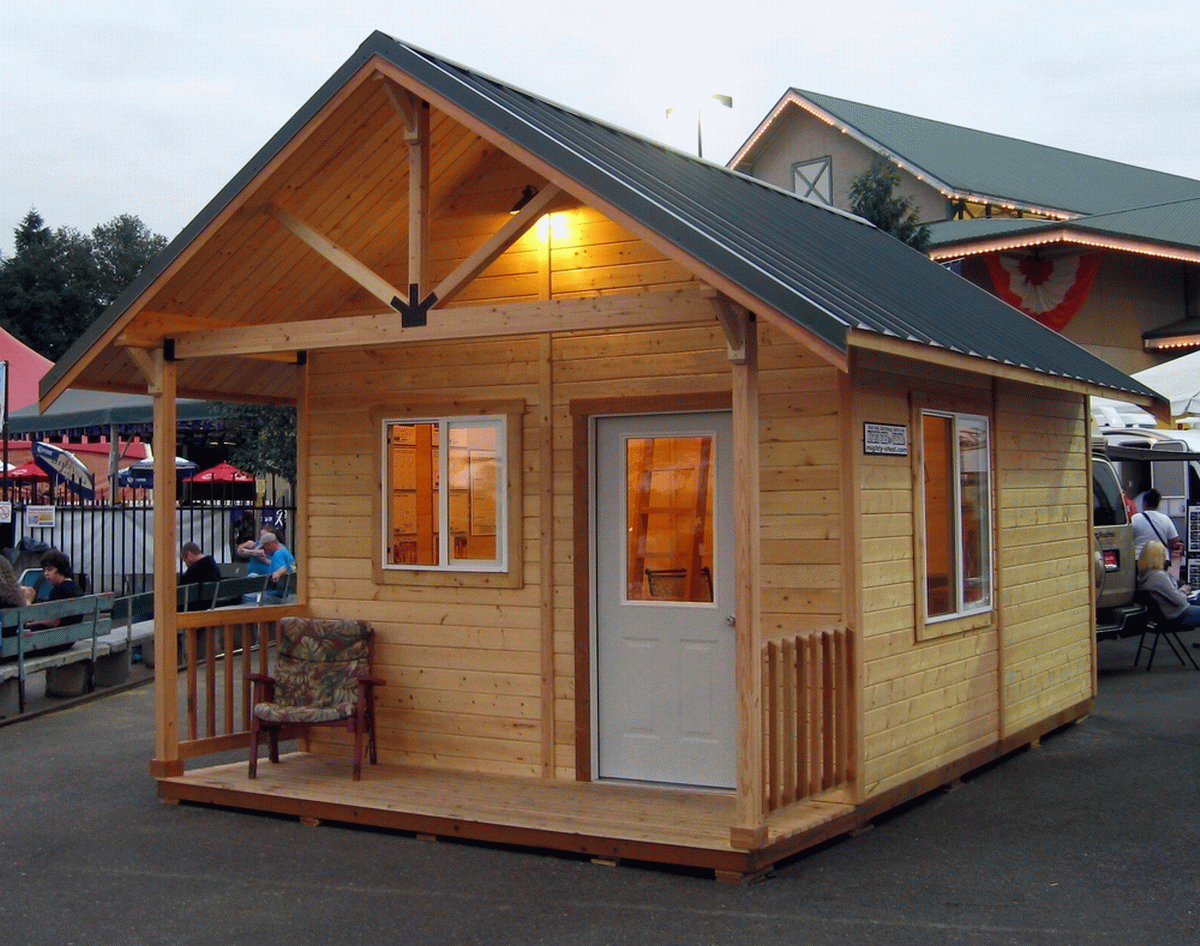
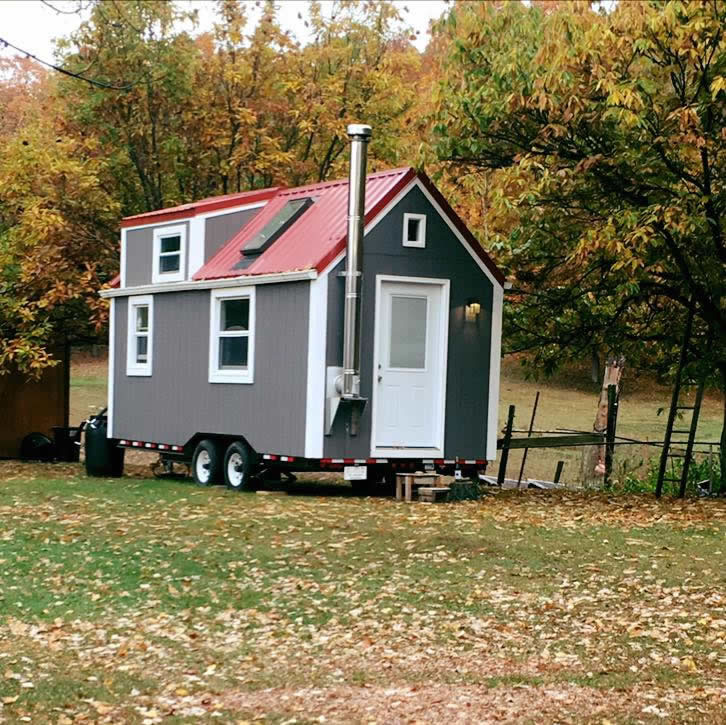
I was gonna comment on the front page somewhere, but when I got to the bottom, I saw this picture; this tilt roof is the obvious style I’d use, since it offers a lot more space than an A-frame.
Great Article! – Gives everyone something to think about and an end goal to aim for.
I know that the route I took to get here was the “Tiny House route.” But having said that…. you don’t have to “downsize” to live off-grid.
I live in a 2000 sf house and am living off-grid. I have 6 solar panels that all together equal less than 1 KW – I have a bank of 20 6 volt batteries and I produce about 3 KWs of power on a normal day. Even on cloudy days I produce more than 1 KW.
I have made substantial changes in the household in general which allow me to run the house on just the solar panels.
I have an 18 Cubic ft refrigerator and a 21 cubic ft freezer that run on propane. this eliminates the bulk of my electrical consumption.
I don’t have any TVs’ currently hooked up which takes another big chunk of power out of the equation. I will in the future, have a projection TV installed and have essentially a 4 ft screen TV for the electrical cost of 1 75 – 100 watt light bulb. However I do have 1 – 4 laptop computers going in the evening along with the internet, so I don’t lack for entertainment!! LOL
Anything that produces heat eats an incredible amount of power so I have eliminated them. I.E. Microwave, Toaster, Iron, Blow dryer, coffee maker, ETC…….
The simplest thing to do is eliminate the incandescent light bulbs, All of my light are CFLs’.
The final step is the heating of the house. We removed our gas furnace with it’s attendant electrical brain, blower, and all the other bells and whistles and went with a wood stove. This works well in our super insulated house. The only downside would be that the fire needs to be tended in order to keep a constant temperature in the house so I am looking at an oil stove to keep the temperature all night. These heaters burn WVO or biodiesel oil and use no electricity!
Anyway the point is – you can live off-grid, comfortably, and in a fairly large space. You don’t have to give up EVERYTHING to go green.
If you already are on wood, why go to oil? I would look at pellet stove feeder whcih you can use all the time but definiety overnight with no hassles except limited power for the auger feed. You will be light out overnight and probably can use a low voltage DC motor for the auger feed.
Great article! Quick and to the point on each subject. At some point, fuels will be depleted and the Earth will come clean…
I would love to be off the grid entirely. I always imagined starting without any electricity and down the road installing a personal system but in the area where we are hoping to buy land it is a legal requirement to have a standard sewage, in home water, and electricity. Any advice on how to live both simply and legally?
The loveable loo system is illegal in most areas. For most the NSF certified compost toilets are the only legal system to use, and still you may have to explain yourself and fight for the right to use one to the dumbed down people in charge of the slaves.
For the truth about the legality of the lovable loo be sure to read Jenkin’s book. http://humanurehandbook.com/
Also in this episode of PeakMoment Dee Williams describes the loophole she uses that makes her lovable loo legal in her neck of the woods. Not entirely ideal but workable. http://www.youtube.com/watch?v=Q8F8cpXg_n8
If you find a remote place and keep quiet around people who are obviously jerks, will anyone even notice or ask questions?
I mean I say this as a youth with a really questionable stance on legality (see: raised on piracy), but this seems silly.
I agree wholeheartedly with the notions put forth in this article. HOWEVER, I’ve done a bit of research. A composting camode starts at around $2000, not $1000. Go with the lovable loo, if you can. I find that, no matter how ecologically advanced, most permit granting people will insist on at least a dry well for the disposal of grey water. Another expense. Then there’s the Rainwater Harvesting problem. I would love to find a system for under $4500. That’s about where the companies start. And, I have a question no one seems able or willing to answer: When the snow is on the roof, how do you melt it and keep it melted and flowing into your fancy RWH system during the 6-8 months of sub-zero weather? I am playing with the idea of using a “HotEdge.” But don’t know if that will actually work. I will probably wind up hauling buckets of snow to heat on the “efficient” wood stove you were talking about, which will run about $4000.00 from Kimberly Stoves. Oh, the Hot Edge isn’t cheap, either, even for a small cabin. Have you priced a Solar System? You had better be Extremely Frugal, if you hope to get by on Solar–or rich. Wind power starts at around $10,000.00 for a system that gives you 400kwh per month–probably less. And, what if the sun don’t shine, or the wind don’t blow? I will try to collect rainwater, I employ the lovable loo, and put in a greywater dry well, but, I think I will have to go with the public utility company on the electric. I have read alot of articles that gloss over the realities of living off the grid–usually by people who haven’t tried it–yet. Would rather read articles written by “them that’s doing” and with a nod to the EXPENSES and challenges involved.
These are all great ideas… building a house made out of pallets, or something, maintaining it, etc, etc…. but the main question in my mind is, WHERE does one find a place to build such wondrous things…?? I wouldn’t have a clue, please can somebody guide me…?
I moved my tiny house to it’s permanent off grid location 6 months ago. What I did for my toilet after converting it from a normal one to an RV toilet is:
1. Took a 50 gal plastic barrel & drilled 1/2 inch holes all over it.
2. Dug a hole directly under where the toilet sits. Filled it about a foot high with rocks that act as a drainage field, & put the barrel in.
3. Hooked an abs pipe from the toilet to the barrel in the ground and covered it with dirt.
It’s just me who lives there so it would take a long time to fill up, plus I put enzymes to speed up the composting process. It’s worked pretty well so far for not having water.
That’s a good little system, we used similar at a camp years ago and for minimal use it was great.
I’m glad I found this.
I like the idea of tiny homes but the idea of water in particular has kept me away from it. I never thought about rain water collection. Thanks for all the info.
Josh
Great rundown post I keep coming back to. Figuring out my on grid vs. off grid options right now has me banging my head against the wall! (Ok, maybe I’m dramatic 🙂 ) While I’m hoping to only allow myself for up to 1500 watts of attached grid electric, I’m trying to keep everything else through composting toilet, wood stove, propane. Figuring out where my grey water will drain is bugging me too, but I love reading some of the suggestions people have made. Ah, community, it’s a beautiful thing 🙂
I’d LOVE to live in a tiny house. The only thing this article doesn’t address is WHERE can we live off-grid LEGALLY, full-time? I’ve seen where even desert dwellers are being harassed by our wonderful government. Perhaps if they didn’t live in junkyards they would draw less attention to themselves. But in order to get a certificate occupancy, the house has to be a certain square foot minimum and connected to the grid. Putting the houses on wheels doesn’t sove this because you’re required to move them so often. Not trying to be negative. Maybe now is the time to bring this fight to congress.
I for one am becoming more aware every day of the unnecessary independent use of power and water. I used to climb into a shower and used 10s of gallons of water. When I started using off the grid methods in this new found lifestyle, water was my first waking moment, I showered with a power head via pump into a drain when finished tub. I couldn’t lift the tub to empty it and had to fill the reservoir before anyone else could use it. Now, with a gravity fed system I use less than 1 ½ gallons and am very clean in the end, mostly it is less that 1 gallon. The grey water is used for flushing a toilet. I use 1 cup of boiling water to shave out of a container and no longer run a tap of hot water all the time I am shaving. I put a garbage pail in the bathroom and no longer put small pieces of TP in the toilet and flush at my heart’s content. About the only time I flush with fresh water is first thing in the morning. The hot water tank here is disconnected and no longer runs 24 – 7 and at shower time I boil 2 gallons of water, that is enough to bring shower water up to a comfortable level, and do the dishes and clean counter tops and wash anything that is required. When I put in a solar system I will eliminate the gas it takes to heat that water.
I have 1 low e light to illuminate my entire living space, have gone to a bar fridge at approximately $35.00 a year to operate just to enjoy the spoils of cold milk and preserve bread eggs and condiments. I generally walk to the supermarket for fresh produce, fish, chicken and fruit two or three times a week and spend as much on vehicle fuel in 2 months as I did for personal use in a week. Maybe this helped in bringing my weight down from 286 pounds to just shy of 200 to date. When I lay on my back I can look down and see knees and toes. “go figure” Not that my prior waste bothered me or bothers me now, I was ignorant. Like many main stream people today. Just drive by any home and count the lights on, that was me, two times over. My efforts will never pay for past sins but it sure as hell cuts down some and has made me a little healthier and a whole lot more conscious of my waste. Has it cut down on my comforts of life, not one iota. But you will never get me to reuse grey water for anything except flushing the toilet no matter how much you think you can filter it other than maybe irrigating a field, I think, at this time anyway…
I am not saving the world but hopefully with a little more time and more education I will save a little of mine. Great informative advice given out here. Thanks
I love these “starter” articles. They make it seem so easy. All you need is enough land and motivation to forgo what technology offers the rest of the population, sort of… You still need a lot of that technology and industry to really build a state of the art energy efficient dwelling.
You also need real options. You need more than suggestions that are punctuated with the terms “may be a viable alternative ” and “may be able to “. I think the article is misleading and not as helpful as we want to believe it is.
Technology is what has brought us out from the brush huts and caves. I have an idea that we should not so dismissive of it as this article suggests.
Finally, the limited resources side of the equation that all of these articles use as their basis of design ignores the other side completely. If you don’t already know, that other side is overpopulation. Moving everybody into small sustainable homes on an acre of land each is never going to solve that problem.
Sensible, organized thinking and discussion will have a better chance of saving the planet than crapping in a bucket.
Thanks Paul. I always appreciate honest feedback.
I would just like to say that some of your ideas are ok but for quite a few people they aren’t. First off if you are older or have asthma or COPD you can’t use wood because of the smoke.. Secondly you shouldn’t compost for reuse poop made from human or most animal waste as it is UNUSABLE because of the meat content.. ONLY vegetarian poop should be composted like mushroom or manure from cows or sheep etc. Poop with meat in it is contaminated and would contaminate what you eat also if you use it. As for the compostable toilet again that is a great idea but not good for older people. We can’t lift too much or too heavy , but the sawdust, it works great but also wheat husks from a pet shop (cat litter) works good also..
Another Sly individual here I see, you described me to a T with age, COPD, weakening a bit plus other things related to being around some time. As someone who advocates Kitty litter, could you tell me, do you use a urine separator? I go off grid in my weekender and tried the bucket and Kitty litter and didn’t have much success keeping odors down and dispensing with it as any acceptable form of solid and did use lots. Also, what do fined being an acceptable way to dispense with the finished product? That has never been explained.
I am not taking the time to get into composting much at present because there are so many other things I am doing but the weekend sometimes turns out longer and the portable toilet is only there hopefully as a backup but end up using it mostly.
hi, thanks for sharing, are you still living off grid in ireland ? i am looking to buy a house there and was seriously considering off grid living…i wonder have you any contacts etc i could get imformation.
many thanks.
Hey there, I looked into the Bioship sewage treatment and it looks awesome but is it ready for purchase/use? I couldn’t tell