The idea of living in the trees is a fun one to imagine. Treehouses are one way to set yourself aloft, but suspending your tiny place with cables or straps is another. Here are a couple of clever examples of folks who’ve brought these visions to life.
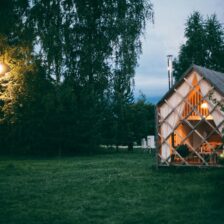
This first example is from Erik Pirolt, an artist in Norway. It’s called Flying View and you can see more of it on his website.
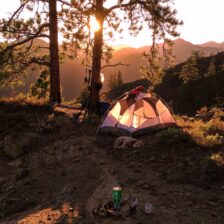
This next suspended structure is a 20 pound tent that can be setup in as little as 10 minutes. It’s called the Tentsile Stingray and it costs about $1350 (check website for current pricing). It’s the creation of treehouse architect and inventor Alex Shirley-Smith. It just needs three trees (anchors) and uses heavy duty ratchet straps to create the tension needed suspend the tent.
The production model became available in March of 2013 and was developed in partnership with product designer Kirk Kirchev. It can sleep/suspend three adults and their gear. They suggest suspending it about 4 feet above the ground for easy access but it can be placed higher in the trees.
If you have seen any other cool suspended tiny living spaces, please email me links at email hidden; JavaScript is required.
Also… thanks for Oliver Swann at Natural Homes for the Flying View tip!
Before the lure of internet took hold of my priorities, I was a potter – a good potter but a poor potter. While I had studied architecture in school, I ended up leaving with an art degree in ceramics. Not all ceramics majors think of themselves as potters, many, no most, think of themselves as artists or sculptors. But some of us are drawn to the ancient craft, the spinning wheel, the fire, the utility the things we make provide.
But these days it’s tough to earn a living doing something that takes so much time to do. So like so many, when the internet took-off I jumped on and found another way to apply my creative skills. I never lost that love for doing things the hard/right way – just got my priorities rearranged; societal pressures seem to have a knack of doing that.
I suspect you might know what I mean. So many of us get caught up on the treadmill that drives the current paradigm – our current way of life. It seems like if we don’t focus all our attention on acquisition – making money, making progress – we’ll fall behind and somehow fail.
In the video below we see a man finishing an axe. His name is Cody and he lives on a homestead in the woods of southern Washington. He once ran on the treadmill too, but today he lives simply and stays very busy with many projects like crafting this axe. Incidentally one of his other projects is a tiny timber frame cabin, which is probably patiently waiting for warmer weather.
But why make an axe!? You could go to the store right now and buy a Made in China axe for 30 bucks. Bringing an old axe head back to life and crafting a handle from a carefully sought & selected piece of hardwood would take so many hours, it would hardly be worth your time. All that time could be far better spent earning many times the cost of the axe too.
I’m probably preaching to the choir, but Cody’s video gave me an opportunity to reflect. It reminded me that maybe the biggest difference between our modern society and simpler times is in the values we hold highest.
Focusing on acquisition has brought us advances & riches but they’ve also come at quite a cost. I suspect many of us are drawn by the lure of tiny houses because they embody a value shift that resonates with us. A value shift where things like freedom, love, peace, and balance are held in higher regard than acquisition. Acquisition is still there, but it takes a back seat instead of center stage.
The revolutionary in me says that maybe this is the answer to many of our troubles and may explain why the powers-that-be are constantly working to control more. As masters of the current paradigm these people would naturally be obsessed with acquisition & control since these two things are required to be successful in the current paradigm.
The revolutionary in me also tells me to share ideas like this, in the hope that if enough of us see the danger that comes with holding acquisition above all other values, we might choose to hold other values higher ourselves – and demand it of the people we elect to govern our collective affairs.
A higher standard we need – not because it brings us more riches but because it brings us closer to each other, and the things that help us thrive.
I know I tend to read a lot into things so thanks for your patience while I wax poetic. I hope you enjoy the video.
Where to build? Where to live? Well this is just out… the USGS & NOAA have issued a report that warns that coastlines are becoming increasingly hazardous and costly to live on due to climate change impacts. Some of the expectations relayed in the report include a rise in health issues for coastal dwellers, stronger storms, changes in precipitation, increasing potential for damage to infrastructure, and higher insurance rates.
Ironically from NASA we’re hearing more reports that climate change can be partially attributed to the sun – in other words it’s not just us. In fact I think they should retitle this recent NASA article to, Climate Change… it’s the Sun Stupid.
Don’t get me wrong, I’m all for reducing our carbon emissions, getting off fossil fuels, and reducing consumption of all things. I’m also not looking for a scapegoat – I’m happy to think it’s us. But I also don’t want to turn a blind eye to the truth – and the truth that’s emerging for me (after months of tracking news of the sun) is that the climate change we’re witnessing has a lot to do with the sun’s activity – and lack of it.
Hey maybe Al Gore can do a new film… An Inconvenient Sun Spot! Just kidding
You see the sun has a normal 11-year cycle of ups and downs. During solar a maximum we typically get more sun spots that send energy toward earth. We see the impacts as Aurora Borealis and disruptions to radio transmissions. Right now we’re approaching the end of a solar maximum that looked a lot more like a solar minimum, and has some saying publicly that sun is affecting our climate.
A few even go a step father by pointing out that the last time we saw this trend it was followed by the Maunder Minimum, a period of even quieter solar activity where the sun sparked off very few sun spots and seemingly caused The Little Ice Age during the Middle Ages.
It’s one thing when the alternative media reports on these issues, it’s another when NASA, NOAA, and the USGS start reporting that climate change is serious business and it’s not entirely our fault – and completely out of our control.
Design for Resilience
Which brings me back to housing and the importance of things like mobility, sustainability and resilience – not just for homes but for life. I think we can all safely say that climate change is very real – no matter the cause – and that impacts to life are on the table. So it seems perfectly logical to begin making changes in how we live.
Some core requirements for this design may be:
Downsize - an ideal strategy with a lot of benefits for today’s world and as a hedge against unforeseen changes tomorrow. Think of it like going for a day hike with a 10 pound pack versus a 50 pound pack- which makes you more agile?
Mobile - easier for those who’ve downsized. Wheels under your house can help too but it’s really the lifestyle and work you choose that impacts your ability to be flexible.
Sustainable - also easier to achieve after you’ve chosen to live with less – because there’s less input required to keep things moving.
Resilient - achieved when you’ve mastered the inputs and outputs – adding that spring back to life.
Happiness & Peace – the goal ultimately. I realize that some think the goals is power & riches but I think most of us think that’s just crazy. Hopefully someday soon those Yertles will fall from their towers of turtles and the rest of us can go back to living. I just hope the mess doesn’t slow us all down for too long. I guess that will depend greatly on the resilience we build today.
This is just food for thought and a peek into where my head has been lately. It’s one thing to worry about the craziness in the world around us and another to do something positive about it.
I think we’re living in a society where change is afoot and the powers-that-be are scrambling to find a way to stop or slow the changes. Everything in their beings tell them to tighten their grips harder in an attempt to control the situation and keep from falling – not realizing that the game is over.
It’s time to put away the Monopoly Board, pack away the funny money, bag up the houses & hotels, and get back to playing tag outside – rain and all. The paradigm is shifting.
Here’s a fantastic idea with what looks like some tinker toy inspiration origins. It’s a modular building system that could be easily deployed for disaster housing relief but could also clearly be used for all sorts of housing solutions from tiny homes to larger multi-family communities.
The inventors are currently running a Kickstarter campaign to raise funds to take the next step. What you see here is a prototype they’ve built to prove the concept (below) and an expanded view of the design (bottom). Learn more about this prefab design at Ablenook.com.
On 12/12/12 the Federal Reserve announced QE4 (Forbes). I guess they weren’t seeing enough impact from QE3, which was printing $40 billion a month to buy mortgage backed securities. Now they’ve more than doubled that bet by promising to print $85 billion a month until unemployment is under 6.5%. You might be asking…
What is QE?Quantitative easing is a extreme measure used a central bank to stimulate an economy. Literally speaking the central bank creates new money to buy assets, in this case the Fed will be primarily buying treasuries issued by the U.S. Government. In other words they are taking extreme measures to protect the value of the U.S. Dollar by buying the paper that backs it – which ironically technically devalues it.
Why should we care? It’s a sign that things are going very badly for the economy. Since most folks have bought into the current paradigm lock stock and barrel its understandable why the powers-that-be are taking such measures. Today it’s considered normal to live in perpetual debt, commute long distances to work for multi-national corporations, rely on the steady supply of goods from overseas, an so on. That doesn’t sound ideal but these are realities of the current paradigm. Well folks… the current paradigm is fatally flawed and a paradigm shift of some kind is on the table. I can say this with certainty because we see evidence everyday that the powers-that-be are prepared to do anything to protect it. There’s no way to know how long these extreme measures will work but one thing is for sure, big change is needed to fix it or it needs to be replaced.
What does this have to do with tiny houses? Everything. Beyond being adorable functional homes, tiny houses represent an idea – that extreme downsizing doesn’t have to mean hardship. Extreme downsizing by choice, or even the mental preparation to downsize, is a step away from the current paradigm and toward a better one, one that doesn’t have to require going into debt. It’s the realization that there is another way to live with dignity and comfort.
At this point I think the 2007-2008 recession never ended and was only bandaged-up, and I’m in good company (Forbes). Most of the evidence comes in the form of monetary policy, as it’s the most publicly visible. Some say that market rigging like the Libor scandal and high frequency trading also show signs that the powers-that-be will do anything to protect the current paradigm. But looking at the crimes committed to protect the current paradigm shifts our attention away from what we can do to move to a new one.
Make a Plan for a Paradigm Shift
For a moment lets say we knew for a fact that the way things are today will change. What would we do? I’m going to suggest we begin by looking at the things we rely on today, and then build a plan that helps account for rising costs and availability reductions. Here’s a quickly brainstormed list of things we rely on in no particular order:
Paycheck
Rule of law
Affordable transportation
Ability to borrow money
Ability to pay rent and mortgage
Uninterrupted global supply chain
Affordable energy to heat and cool our homes and workplaces
Municipal services like water, sewer, and trash
National security
These are also the things that the powers-that-be are working tirelessly to protect – which on the surface is a good thing. But we also know that these these things may be difficult to maintain indefinitely under the current model.
So any step we each take to account for each of these things is a step toward a new paradigm. This approach doesn’t require that you walk-away from how you live today, it actually leverages how you live today and allows you to begin paving a path to another kind of future.
So here is quickly brainstormed list of things we can do to account for the rising costs and the reduction in availability of the things above:
Paycheck – Lower living costs and build alternative income streams. Take your hobbies, expertise, experience, and skills, and begin finding ways of making them available to others. Peer to peer commerce is a very small entrepreneurial step each of us can begin augmenting our paychecks.
Rule of law – Improve physical home security, reduce vulnerabilities, build connections with neighbors, and stay vigilant. No matter how high or low the crime rate goes, working toward improving your personal security is always sound advice.
Affordable transportation – Downsize your vehicle and length of commute. If you plan to move include the walkability in your decision making process.
Ability to borrow money – Reduce spending to a level where borrowing is not needed. Diversify savings in tangibles (food, gold, silver, land, tools, etc) and intangibles (paper financial investments, savings accounts, retirement accounts, etc). Pay down and eventually eliminate debt.
Ability to pay rent or a mortgage – Downsize and bring housing expenses to a more easily manageable level, and/or build a tiny house backup plan.
Uninterrupted global supply chain - Shop locally and discover local producers of food, goods, and services – in other words shop with those those that don’t currently rely heavily on transportation to bring those good to market.
Affordable energy to heat and cool our homes and workplaces – Downsizing helps tremendously here since it’s cubic feet of space you must heat and cool. Learning to live more frugally can also provide added protection.
Municipal services like water, sewer, and trash – Reducing consumption, increasing recycling, and learning how to manage waste yourself can reduce your reliance on these services.
National security – We might assume that this is the job of the government. But I’m going to argue that it’s a citizen’s responsibility. The more of us that choose to live within our means, improve our own self-reliance, and prepare for uncertainly, the more secure our nation (and economy) becomes.
Now just image… if the majority of us lived in sustainable homes without debt & mortgages, had diversified incomes and savings, worked in the communities we lived, and had the means to ensure our own personal safety, would there be a problem at all?
The paradigm shift is a shift in thinking. Think tiny.
Jay Shafer brought tiny houses into the public eye when he appeared on The Oprah Winfrey Show (original video here) in February of 2007. At the time the idea of living simply in a small space was refreshing approach that inspired many to follow. Jay’s Tumbleweed Tiny House Company thrived over the following years as more and more people discovered tiny houses.
But now Jay has chosen to resign from his position at Tumbleweed to start a new endeavor - Four Lights Tiny House Company. Here’s a quote from the announcement:
“When asked why he split with the business he founded in 1999, Jay says, “For some of the same reasons I started designing, building and living in small houses in the first place – for more freedom and more manageability. The message and design philosophy I’d built my original company on had become harder and harder to maintain as the business grew from a one-man operation into what it is today.”
Four Lights will launch by offering Jay’s first-ever unabridged, hands-on building workshop, his plans for a tiny house village (slated for completion in 2015), and a new 280 square foot home design. An additional house will be unveiled every month for the next five months. Jay’s designs for compact furnishings and his system for “design-it-yourself” tiny houses will be released thru fourlightshouses.com on January 31.”
Cody (a.k.a Wranglerstar) is one of the folks I follow on YouTube and Facebook. He regularly posts great how-to videos he films on his homestead near White Salmon, Washington. While this short video series focuses on building a greenhouse, it demonstrates how quickly the shell of a small building can be framed. He found the plans for this greenhouse at Ana White’s website.
While a small building like this is not unlike a tiny house there are some significant differences which will add to the time and cost to a tiny house project. As you can see here the shell of stick framed building goes up quickly. To make it comfortable for living more steps are needed like making it weather tight, insulating the shell, finishing the interior, installing utilities, and so on. Learn more about how to build a tiny house.
Cody is also working on a timber frame cabin and documenting every step. Compared to timber framing, stick framing goes very quickly as you can see in the greenhouse construction videos below. You can also watch them on Cody’s YouTube Channel.
I’ll add the final video(s) when Cody posts it on YouTube.
I have five signed copies of my book to giveaway. Tiny House Floor Plans is quite literally a book of floor plan drawings that can help you visualize how a tiny space might be organized. You can buy a copy on Amazon.com and an ebook version right here. If you’re feeling lucky you can enter for a chance to win a signed copy (U.S. residents only). For international winners I’ll send you an electronic copy of Tiny House Floor Plans and one electronic copy of one of my house plans.
My last giveaway was so popular, and so many people still hoping to enter, that I thought I’d offer another right away.
Increase your chances to win by a factor of 10. If you’ve already done some of these things, like following the Tiny House Design Facebook Page, be sure to give yourself credit by clicking ‘do it’ above.
Details
Prize: A signed copy of the book Tiny House Floor Plans (U.S. residents only). International winners will receive an electronic copy of Tiny House Floor Plans and an electronic copy of one of our tiny house plans. 5 winners will be selected.
Open to: A valid email (and mailing address for U.S. winners) is required so we can notify you and send you your prize if you win. We will not share your email address with others. Void where prohibited.
Giveaway period: Starts at 12:01 am on September 15, 2012 and continues until 12:01 am on October 1, 2012. All times are Eastern.
How to enter: Rafflecopter – Log in with your name and email or Facebook.
If you’re viewing this in email you’ll need to visit the website to enter. If you’re on the website and the rafflecopter form doesn’t appear, please wait a minute for it to load.
A suggestion for Tiny House Design affiliates: feel free to leverage this post & giveaway widget on your websites. View page source to grab the javascript or email hidden; JavaScript is required for more info. Don’t forget to swap your book links for mine.
Update: Congratulations to the 20 people that won Your Pick of Plans! We’ve sent out emails to each of the winners (see list below).
Update: This giveaway got so popular on the last day that I’ve decided to extend the entry deadline five days AND will give away 20 plans to 20 winners instead of just 10. Also remember you can enter 10 times by completing the items below in the Rafflecopter entry form.
Enter for a chance to win your choice of one of our tiny house plans or an electronic copy of the book Tiny House Floor Plans by Michael Janzen. 1020 winners will be selected and you have 10 ways & 10 15 days to enter – see details below.
Increase your chances to win by a factor of 10. If you’ve already done some of these things, like following the Tiny House Design Facebook Page, be sure to give yourself credit by clicking ‘do it’ below.
Open to: A valid email is required so we can send you your prize if you win. We will not share your email address with others. Void where prohibited.
Giveaway period: Starts at 12:01 am on September 1, 2012 and continues until 12:01 am on September 10 15, 2012. All times are Eastern.
How to enter: Rafflecopter – Log in with your name and email or Facebook.
If you’re viewing this in email you’ll need to visit the website to enter. If you’re on the website and the rafflecopter form doesn’t appear, please wait a minute for it to load.
A suggestion for Tiny House Design affiliates: feel free to leverage this post & giveaway widget on your websites. View page source to grab the javascript or email hidden; JavaScript is required for more info. Don’t forget to swap your book links for mine.
A gabion is a metal cage (box or cylinder) filled with rocks (debris, concrete, gravel, sand, etc). Normally these are used as retaining walls in big & small landscaping projects. You might also hear the word hesco used with the word gabion. Hesco is a company that makes gabions used by armed forces as walls to protect soldiers from enemy fire.
I spotted a video on YouTube that showed the assembly of such a gabion that was used as a gun emplacement. It had walls, a doorway, window opening, and roof – just like a house. You can watch that military gabion shelter assembly video online.
So the thought popped into my head… why couldn’t a house be built from gabions? The building materials would be simple, wire gabion boxes, fill material, road base gravel for the foundation, a bit of concrete, your choice of roof, some stucco, and interior finishings.
In this imaginary example the interior space is very small, in fact just 135 square feet (9′x15′). It has a bathroom, kitchen, sofa bed and wood fireplace. A larger space could theoretically be built without adding much to the materials list so let this tiny space serve to get your imagination rolling. Continue reading →