Tiny Prefab, A Do-It-Yourself Prefab Building System.
PDF format – 90 pages – $19.95
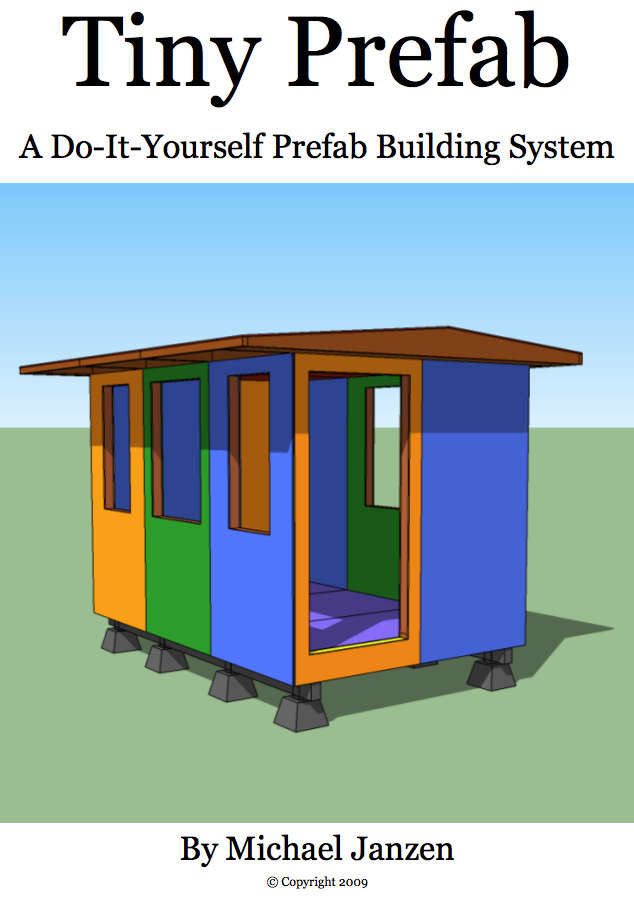
This book contains the plans and instructions for a tiny prefab building system that is easy to build from common building materials. The system is perfect for someone without a lot of construction experience or spare time because building each individual panel is a relatively small carpentry project in itself.
When all the panels are complete they can be transported in the back of a pickup truck to their final site and assembled. Since most of the actual construction happens while building the individual panels the assembly process can be done with few tools and just a little bit of help from a friend or two.
Below are some Sample Pages
Free Updates
Today the plans are complete but over time I’ll make improvements and additions as reader suggestions are incorporated. When I do I’ll send out a link to the free update to everyone who has already purchased the ebook in the past. So in many ways purchasing an ebook from me is really more like subscribing to an expanding design resource.
Please Note
Before building any structure be sure to check with your local authorities. In many communities permits are not needed when building tiny buildings like sheds but the rules range widely so it’s best to research your local restrictions before building anything. Also please note that these plans were not prepared by or checked by a licensed engineer and/or architect. Build from these plans at your own risk.
Affiliate program
If you’re interested in selling this ebook on your website you can earn a 40% affiliate commission for each sale. Learn more about the Tiny House Design Affiliate Program.


What’s old is new again!
Were you aware that the February 1962 edition of Popular Mechanics magazine had plans for a 24′x24′ vacation house that was built of 4×8 modules intended to be prefabricated by the home owner?
Yes. Actually I noticed several solutions similar to this and was inspired by all of them. I’ll see if I can dig up some of those older panelized building designs to show folks here.
What’s old is often still relevant!
Just out of curiosity, I live in Houston TX. Outside of the city proper there are many deed restricted and unrestricted communities. My main concern is being able to build a category 5 hurricane resistant home, do any of the small house/prefab house allow or come with windstorm bracing installed that you are aware of??
William
I know that many of the portable tiny house builders use a lot of metal bracing including hurricane straps since the houses have to travel down freeways from time to time but I can’t remember anyone specifically mentioning that any of the houses are certified for category 5 hurricanes.
Hi William,
I live in Houston too and wanted to know if you found any small houses that were hurricane resistant? I’m just starting my small house journey.
Thanks,
Tiki
I’ve been thinking about the hurricane resistant question a bit. Tiny houses built for a freeway can withstand quite a bit of wind and bouncing around. Many people also choose to use hurricane strapping and other metal fasteners to hold it all together. But I hesitate to say if any tiny house is hurricane resistant because so many are handmade and I can’t think of an example of someone sticking around for a hurricane. I think most folks would hitch it up to their truck and move it out of harms way.
As far as the tiny prefab ebook design, I don’t go into engineering details, fasteners, etc. But because it is a bit overbuilt and uses more plywood sheathing and 2×4 framing than most homes I suspect you could easily add the necessary hurricane strapping (per your local codes) to make it as sturdy (if not more so) than a normal house.
Another option to look into for a permanent house that is known to be hurricane resistant is earthbag construction. It’s a totally different aesthetic and can’t be dismantled and moved like a prefab but it might serve folks on the gulf well. Just a thought.
I would like to know if the book as a section on how to set up the shower, and sink? I’ll get an electrician for the other stuff, but I plan to live in it and want to do the plumbing myself.
Hi Alex,
There is no plumbing or electrical details in the book. It is focused on the panel system primarily.
Thanks!
Michael
Hi Michael,
We are planning to build an 8 x 12 tiny house with a loft. I’ve noticed that your 8×8 design doesn’t have any space above for a loft. However, you state that the design can be modified to expand in 4 foot increments. Is there a roof design that can accommodate a loft within an 8×12 in your plans?
Thanks,
Isaiah
Hi Isaiah,
The 8×8 (or 8×12, etc) tiny prefab doesn’t have a steeper pitch roof in the ebook. I did draw an example of a 12/12 pitch with standard framing for the 8×8 free plans. http://www.tinyhousedesign.com/free-plans/
In the Tiny Prefab ebook there are examples of how a loft panel can be put atop a 16×16 house. You could build three of those 4×8 panels for a 8×12 and then frame a roof, or adapt the 16×16 roof for a smaller 8×12.
I will add this suggestion to the next version of the ebook. It would be a useful alternative to the design.
Thanks!
Hi Michael,
Thanks for your reply! We’d love to purchase the book. When we do, is it possible to also get a sketch up model of this plan?
My partner and I are talking about merging the plans for the tiny prefab with your plan for a camping cabin, so I was also wondering if it might be possible to buy the sketch-up model of the house below:
http://www.tinyhousedesign.com/2010/01/11/camping-cabin-rough-house-plans/
Thanks! We’re beginning house-builders and are big fans of your work.
Meara and Isaiah
karmod prefabricated buildings
http://www.karmod.eu
I have to think these won’t be hurricane resistant without tiedowns and berming with some kind of sandbag. These structures are so light (relatively speaking) with a high wind load that 115 mph would probably roll them at least, or carry them away if they aren’t somehow restrained. If they can be built with an aerodynamic end that can be pointed into the storm it would help, like an upturned boat.
Richard Gay
Austin
Michael, I live in a cold climate. Does your ebook discuss insulating the walls and floors? It is January and -14C outside and I’m itching to start on a new project I can assemble in warmer weather. Thanks!
Would you consider this design to be reconfigurable? In other words, could you reuse the panels in an 8×12 to make a 161×16 later?
Yes. But the more interior/exterior finishes, wiring, plumbing you add the harder it would be to pull apart and reconfigure. So if you plan to take it apart later noodle through these improvements before installing them.
Is it possible to build an octagonal structure using the wall panels? I realize the roof panels probably wouldn’t work.
Hi Michael,
I’ve been looking for plans to build a temporary small structure that could serve as a guest house. I’d like to know if any of your houses/cabin can easily be taken apart/rebuilt every summer, and taken down again in the fall?
Twenty dollars for a 90 page PDF? You sir, are exactly what’s wrong with this world. I’ll be purchasing this under a different name soon, and spreading it like wildfire through pirate sites.
When I chose to publish a PDF online I knew there was risk of someone posting is elsewhere online. It’s a risk I’m comfortable taking.
What bothers me about your comment is that you have no idea what ‘Capitalism at it’s Finest’ really means.
‘Capitalism at it’s Finest’ is billionaires, working through their corporations and governments, exercising free reign over world economies and controlling the power to take the whole thing down. Too much power is now concentrated in the world’s richest capitalists and we’re all suffering from it.
When individuals produce things to trade things they’ve worked hard making (yes sometimes for money) it’s the right level of capitalism – peer to peer, person to person. We empower each other when we buy from each other – other real people.
So here’s a suggestion… why not use that anger of yours and find a way to slow and stop the wildfire of billionaire greed and plot against someone worth plotting against. You might find yourself making a lot more headway than by attacking individuals who are trying to do some good.
If you’d rather trade something you’ve made for a copy of my ebook I’d be happy to take a look at what you have. If it looks like a good trade, you’ve got a deal.
What the Hell is wrong with “Capitalism at its Finest” above? Nothing better to do than tear down the small business guy? You have it exactly right Michael. Kudos.
Is it feasible to use 4 x 1″ on the outside elements of a panel where they join another and thus the 4 x 2″ is formed from the join. If this will work surely there is some saving from using two 4 x 2″ studs etc.
Hi John,
Great question.
2x4s at the joints do make some stout (and possibly overkill) connections between panels – but I personally think it’s the best way to go since the studs are 24″ O.C. and the panels are not connected except with the spline.
But I bet if you kept the weight of the roof low the 1x4s would work too. But like I hinted… I’d error on the side of stoutness in this case.
Another thought though… while we’re on the topic. You could also try using one 2×4 that’s 3/4″ exposed and leave it off the other side. That would reduce the number of 2×4 and even give you more places to screw the panels together.
Thanks!
Michael
The very first post back in 2009 referred to a Popular Mechanics issue about a prefab house. I found the full article via Google books for free to view. Here is the link for all to enjoy.
http://books.google.com/books?id=reEDAAAAMBAJ&pg=PA7-IA2&lpg=PA7-IA2&dq=February+1962+edition+of+Popular+Mechanics&source=bl&ots=f7UOzTmXU0&sig=1HfiuIUfvDsRkuVl0aAMoePn0xI&hl=en&ei=L62xTYyJIcH50gH67uybBg&sa=X&oi=book_result&ct=result&resnum=7&ved=0CEUQ6AEwBg#v=onepage&q=February%201962%20edition%20of%20Popular%20Mechanics&f=false
Very long url. If it doesn’t come up as a clickable link, just cut and paste it into the address bar and away you go. Looks like you may be able to use Google books to get at other such articles if people know the magazine, month and year to search. Hope that helps.
Wow, some pretty alarming articles in that magazine as well as the useful ones. Cringeworthy stuff abounds.
I’m considering purchasing the ebook, but I need to know if the materials cost is within my budget. Is there a cost estimate for the materials?
I’ve not included cost because it ranges wildly with regional price differences and actual material choice – especially for plywood. You could do a rough estimate by thinking that each panel is roughly 4 8-foot 2x4s and 2 pieces of plywood.
In my neck of the woods a 2×4 costs $2.50 and 1/2-5/8 plywood costs roughly $20 depending on quality. So a wall panel would cost $50 (ish). Then add $10 for floor panels and $20 for roof panels since there is more wood in floors and ceiling panels.
An 8×8 would need:
2 roof panels = $140
2 floor panels = $120
8 wall panels = $400
$660 is for the lumber only. Then add insulation, screws, glue, wiring, roofing material, windows, doors, etc.
But as you might now see it’s comparable to normal framing. The main advantage of the system is the panelized design which gives you the ability to build offsite and assemble the building elsewhere.
Also, what is the insulation like and what kind of heating would you suggest? Could you live in it in the Northwest Winter?
Hi Andrea. The panel design is mostly a 2×4 based framing approach – the insulation is up to you. I’d imagine that In cold regions you’d want more than 2×4 walls.
Dear MJ,
I am one of the many people who admire small houses. I am from Malaysia and currently in the process of designing prefab houses using our simple ready-to-assemble system for the rural poor. I am wondering if your assembly process is easy for a layman to read? It is great to know that there many out there who are ardent supporters of being small houses.. thank you.
Late comment on the Hurricane discussion but I use to live in San Leon and always wished I had known of the Tiny House movement before I bought my home. Having a “House” on wheels, to me, should be the answer everyone is looking for. When the storm is approaching simply disconnect the utilities, if any, hook up to your towing vehicle and take the whole house out of harms way or at least somewhere the danger is minimized.
In my case I would have moved the house to the plant I worked in and parked it inside the Fire Brigade Station. There was more than plenty of room in there for a tiny house.
Tracy