Random Posts
random postsnine-tiny-feet-revised-revised-plans brian-cob-house-dancing-rabbit-walls IMG_0548 waltons-shed

Tiny Pallet House Eco-Village

by Michael Janzen on May 21, 2010

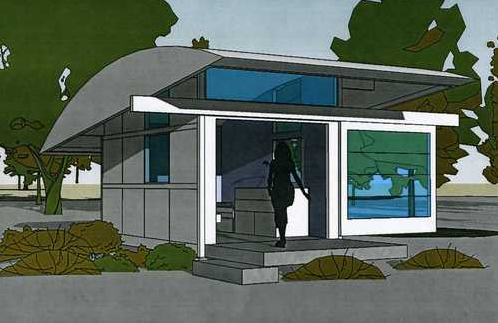
Architect Arthur Dyson is working with students at Fresno State University to build a tiny pallet house eco-village for the homeless. The plan is to use mostly reclaimed building materials like pallets for the structures, cardboard for walls, and aluminum cans for roofing.

The project is still looking for a final location but the city of Fresno, California is working to help make that happen, which is very encouraging. I hope this project is successful and provides another example of how eco-villages for the homeless are viable solutions for everyone.

I first spotted this on Jetson Green. I also want to thank Kent at Tiny House Blog for the heads-up. Photo credit Darrell Wong/The Fresno Bee and Arthur Dyson.


8-Inch Thick Wall Pallet House Concept

by Michael Janzen on December 29, 2008

A couple weeks ago I posted an alternative concept for a tiny house built from shipping pallets that simply used half pallets (24″ by 40″) as building blocks to form walls. I chose 24-inch walls for that first post because they can be cut from 2-way and 4-way pallets without any waste. It also seemed like a very stable wall thickness requiring little or no additional structure. But 24-inch thick walls also seems like incredible overkill so I went back to the drawing board and came up with an alternative that still uses the pallets fairly efficiently.

As you can see the trouble with building this way when using 4-way pallets is that the forklift fork notches get in the way. In my scavenging I’ve found that 4-way pallets are much more common too. I chose 8″ walls because that’s the approximate distance from the corner of a pallet top the notch. This seems like the most efficient size when cutting into either type pallet.

In this example there are 19 courses of pallet blocks with 14 blocks per course for a total of 266 blocks. Window and door openings would reduce this number so for fun lets just say you’d need 240 blocks. If you had 2-way pallets this would mean you could build these walls with only 40 pallets. If all you could find were 4-way pallets you’d need 80 pallets.

I’m really starting to think that a concrete slab, or similar masonry floor, would be best especially with south facing windows. The 8-inch wall cavity would be stuffed or sprayed full of insulation and could provide a lot of protection from the elements. The roof should be conventionally framed to provide a safe roof overhead. I still imagine the best wall treatment inside and out would be some kind of stucco since it would give character to the imperfections inevitable with pallets.

I’m very tempted to try this idea. What do you think?

Pallet House Construction Alternative

by Michael Janzen on December 16, 2008

This holiday season has been super busy for me, at work and home. You might have noticed by the lack of posts here and my other blogs. But this particular tiny house design concept has been stewing in my head ever since EJ, one of my readers, sent me a link to a very cool shipping pallet structure. I took this idea and went off on my own tiny house tangent.

I’m currently using pallets to build my tiny free house but keep running into big challenges that this approach would solve. Pallets are often made from hardwood which is really hard to work with. Pallets are also not super sturdy when you screw, nail, or bolt them together vertically. They are really best lying flat and supporting the weight of something heavy. I suspect that laying them horizontally and stacking and nailing them together might be a smarter way to go.

This approach would also make an incredibly insulated structure on almost any size. Think of it like building with any kind of big block, much like how one builds with straw bales or adobe. The difference here is that pallets can be found in trash piles and have an open cavity that would need to be filled with some kind of insulation.

Roof – The roof should really be framed from dimensional lumber. Pallets walls seem safe enough but anything that goes over your head should light weight and strong. A conventionally framed roof seems the most logical. I don’t think I’d ever put a flat roof on a house myself. I’ve got a flat roof now and have been fighting a leak so a shed or pitched roof with a metal surface seems like the best way to go.

Floor – The floor could also be made from pallets but covered in plywood and laid on a dry flat surface. Placing wood pallets on the ground will invite termites and other infestations. I think the best floor in this house would actually be a concrete slab which would also act a a nice heat sink.

Walls – The walls could be covered with anything, stucco, pallet boards, plywood, etc. I like the idea of stucco because the walls as so thick it almost looks like an adobe. The wall cavity would be filled with some kind of insulation. I imagine some kind of low emission environmentally friendly spray foam would be ideal. Stuffing the pallet cavities by hand with something like packing peanuts would be another potentially free option. But the spray foam just seems like it would be much faster and air tight.

Windows & Doors – In college I had the opportunity to help a friend design and build an adobe house in Abiquiu, New Mexico. In an adobe the openings are framed with large wood bucks made from at least 2×6 pressure treated lumber. A header is then embedded in the block wall above the opening. The walls here would be much lighter than adobe but window and door bucks with a header over them seems like a good solution for pallet walls too. The windows and doors themselves could be hand made, dumpster dived, or store bought.

What do you think? Is this crazy or what? Have you seen anything like this before? I’ve not been able to find anyone online who has build a house like this. Have you?